How to Live Stream a Wedding


1. Introduction: Why Wedding Live Streaming Has Become a Global Trend
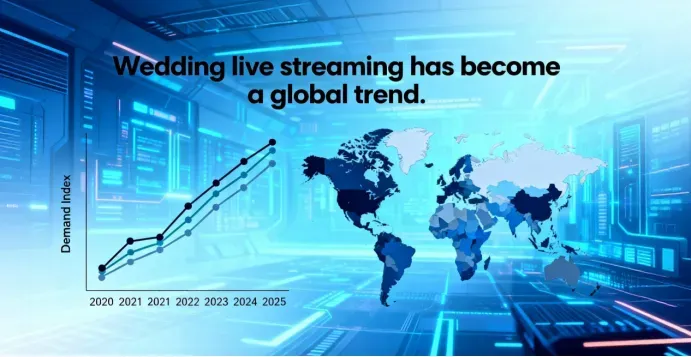
In recent years, wedding live streaming has transformed from a niche idea into a global phenomenon. What started as a temporary solution during travel restrictions has now become an increasingly standard part of the wedding industry. Couples today want their weddings to be intimate yet accessible, allowing friends and family from all over the world to witness the ceremony in real time.
Beyond convenience, wedding live streaming also represents a new cultural shift: people now value digital memories as much as physical ones. A beautifully produced live stream allows the couple to preserve not only the vows and speeches but also the atmosphere, reactions, and emotions of the day. As a result, wedding planners, videographers, and media teams are rapidly upgrading their technical capabilities—and video encoders have become a key part of this upgrade.
This article will walk you through why encoders are indispensable for wedding live streaming, how they fit into the production workflow, and how wedding companies can leverage encoder technology to enhance service value. If you are already in the wedding industry or considering entering, mastering encoder-based streaming workflows is now essential for delivering professional and reliable results.
2. The Technical Foundation of Wedding Live Streaming
Before discussing encoders, it’s important to understand the basic technical chain behind wedding live streaming. A smooth broadcast relies on several connected stages—from capturing video and audio, to switching between cameras, to transmitting the signal online. Since weddings often take place in unpredictable environments with changing light, constant movement, and unstable network conditions, each part of the workflow must operate reliably to ensure a stable experience for remote viewers.
2.1 Video Capture
The workflow begins with video capture using DSLRs, mirrorless cameras, camcorders, PTZ units, or cinema cameras. These devices output high-quality HDMI or SDI signals that need processing before streaming. Because weddings involve continuous movement and unpredictable lighting, ensuring clarity in every shot is essential for a polished broadcast. Proper microphones and sound equipment also ensure guests can clearly hear every word and piece of music.
2.2 Live Switching
Movement and emotional moments—like walking down the aisle, vows, speeches, and first dances—require real-time adjustments. Operators manage exposure, focus, and framing while also handling audio through lavalier mics for the couple, handheld mics for officiants, and ambient microphones.
When multiple cameras are used, a switcher enables real-time transitions between wide shots, close-ups, and audience reactions. This creates a more dynamic viewing experience than a single stationary camera. The switcher may also add picture-in-picture layouts, titles, graphics, or pre-recorded videos while balancing audio levels. These elements help make the live stream feel polished and immersive, giving remote guests a sense of being part of the celebration.
2.3 Network Transmission
After video and audio are prepared, the next challenge is stable network transmission. Many weddings take place outdoors or in venues with weak Wi-Fi or congested cellular networks, making reliability difficult. Live streaming requires consistent upload bandwidth, as even brief drops can cause buffering or interrupted streams. To maintain stability, teams often test the venue in advance and use wired connections, stronger routers, or cellular bonding to ensure the ceremony is streamed without interruption.
2.4 Streaming Platform
The final step is delivering the processed feed to a platform such as YouTube Live, Facebook Live, Zoom, or a private RTMP server. Each platform has its own requirements for bitrate, resolution, and protocol, so proper configuration is essential. Couples may choose public or private viewing depending on privacy needs. Between the camera system and the streaming platform sits the key device—the encoder—which converts professional camera signals into stream-ready formats and ensures smooth, reliable transmission.
3. Why Live Streaming with a Mobile Phone is Not Recommended
3.1 Why Mobile Phones Are Not Recommended
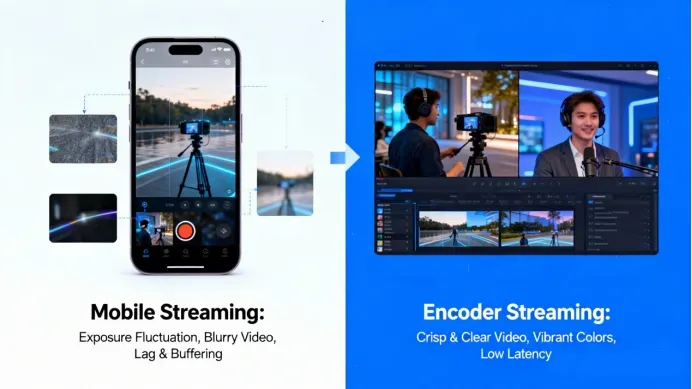
Using a mobile phone for wedding live streaming may seem convenient, but it is not suitable for such an important, once-in-a-lifetime event. First, mobile phones cannot process uncompressed HDMI or SDI signals from professional cameras, meaning they cannot deliver the cinematic visual quality couples expect. They also struggle in unstable network environments—common in hotels, outdoor venues, and crowded locations—often resulting in lag, frame drops, and stream interruptions.
In addition, mobile streaming typically suffers from higher latency, causing remote guests to experience emotional moments such as vows or the first kiss with noticeable delay. Phones also lack advanced controls over bitrate, frame rate, resolution, and color accuracy, making it difficult to maintain a polished, high-quality broadcast. Lastly, mobile devices tend to overheat or crash during extended streaming sessions.
Because of these limitations, mobile phones cannot provide the reliability and professional quality that a wedding live stream requires.
3.2 Why Weddings Need Encoders
Among all streaming equipment, one of the most essential—yet often misunderstood—components is the video encoder. Many beginners assume that a camera can stream directly, but this is rarely the case.
A video encoder is a device or software that converts raw, high-bitrate HDMI or SDI signals into compressed formats such as H.264 or H.265, making them suitable for real-time transmission. Encoders take the high-quality output from professional cameras and convert it into a stream optimized for platforms like YouTube, Facebook, or private RTMP servers.
Raw Camera Signals Cannot Be Streamed Directly
Professional cameras output uncompressed HDMI or SDI signals. These signals are too large and incompatible with streaming platforms. Encoders compress and package them into live-stream-ready formats.
Key Benefits of Using Encoders for Wedding Live Streaming
① Stable and Reliable Streams
Encoders play an essential role in maintaining a stable and reliable stream, especially because wedding venues often present challenging network environments. Many locations suffer from:
- Weak Wi-Fi coverage
- Inconsistent hotel internet
- Outdoor setups with fluctuating connectivity
Hardware encoders are specifically designed to handle these unstable conditions more effectively than laptops or mobile phones, ensuring the broadcast remains smooth even when the network is less than ideal.
② Lower Latency
Encoders also help achieve lower latency, producing faster and smoother streams. This is especially important during emotionally significant moments such as:
- Vows
- Speeches
- The first kiss
Reduced delay ensures that remote guests experience these moments almost in real time, allowing them to feel connected to the ceremony rather than watching events several seconds behind.
③ Better Image Quality and Bitrate Control
Encoders provide superior control over visual quality, which is crucial for capturing the beauty and atmosphere of a wedding. They allow precise adjustments to:
- Resolution
- Frame rate
- Bitrate
- Color sampling
This level of customization allows the streaming team to match the aesthetic needs of the event. The live stream can retain its clarity, color accuracy, and overall elegance, allowing remote guests to experience the ceremony as vividly as possible.
④ Avoiding Device Overheating or Crashes
Using a laptop or phone to stream can easily cause overheating or app failure. A wedding is a once-in-a-lifetime event—there is no chance for a retake. Encoders are built for long-duration, professional operations, ensuring reliability and smooth performance throughout the event.
| Feature / Aspect | Mobile Phone Live Streaming | Encoder-Based Live Streaming |
|---|---|---|
| Signal Input | Cannot accept HDMI/SDI from professional cameras | Supports HDMI/SDI/NDI and pro-grade cameras |
| Stream Stability | Easily affected by weak Wi-Fi or unstable networks | Designed for unstable environments with adaptive bitrate/SRT |
| Latency | Higher delay, not real-time | Low latency, near-synchronous experience |
| Image Quality | Limited control; auto exposure/compression | Full control over resolution, bitrate, frame rate, color |
| Heat & Reliability | Prone to overheating, app crashes | Built for long, continuous, stable operation |
| Suitability for Weddings | High risk of failure; poor quality | Professional, stable, cinematic live streaming |
4. Production Workflow of a Wedding Live Stream
To set up a successful live stream for a wedding, particularly in rural or remote locations with weak mobile connectivity, using a device like the X1 with network bonding capabilities can ensure a smooth experience. Here’s how to do it:
-
Connect the Camera to the Wireless System
Attach the wireless video transmitter to the camera and connect the wireless video receiver to the X1. This wireless setup allows for flexible shooting without long cables. -
Position and Power On the X1 Device
Place the X1 device near the control area. Even with weak indoor signals, the X1’s advanced bonding engine will use all available networks to maintain a stable connection. -
Configure Your Streaming Settings
Access the X1 interface to set your preferred bitrate (e.g., 5000 kbps) and choose your streaming platform (e.g., YouTube, Facebook, or RTMP). -
Start the Live Stream
Click “Start Streaming” to begin broadcasting. The X1’s bonding system automatically distributes data across the connected networks to ensure smooth streaming. -
Monitor the Stream During the Event
Monitor the network performance. If one network becomes unstable, the X1 will automatically switch to other available networks, preventing any interruption in the live stream.
5. Three Common Encoder Solutions for Wedding Live Streaming
| Encoder Solution | Workflow Setup | Pros | Best For |
|---|---|---|---|
| Single-camera direct encoder streaming | Camera → HDMI/SDI → Hardware Encoder → Internet → Streaming Platform | • Simple setup • Minimal equipment • High reliability | • Small weddings • Registry weddings • Elopements |
| Multi-camera switching + encoder | Multiple Cameras → Switcher → Encoder → Internet → Streaming Platform | • Cinematic multi-angle experience • Live transitions • Graphic overlays | • Traditional weddings • Outdoor weddings • Elaborate venues |
| Wireless or NDI-based encoder workflow | Wireless Camera Packs / NDI Cameras → Network → Encoder → Streaming Platform | • Fewer cables • Flexible shooting positions • Ideal for complex venues | • Large venues • Multi-room events • Weddings requiring high mobility |
6. Key Factors to Consider When Choosing a Wedding Live Streaming Encoder
- Stability: Ensure a consistent, stable broadcast from start to finish.
- Network adaptability: Look for encoders with features like SRT protocol and multi-network bonding.
- Video input compatibility: Match your encoder to your camera’s output.
- Portability & power: Opt for encoders with battery power options.
- Ease of operation: Choose encoders with simple setup and user-friendly interfaces.
- Recording capability: Built-in recording can provide a secure backup.
- Latency performance: Low latency ensures a near-synchronous experience for remote guests.
7. How Wedding Companies Can Use Encoders to Increase Service Value
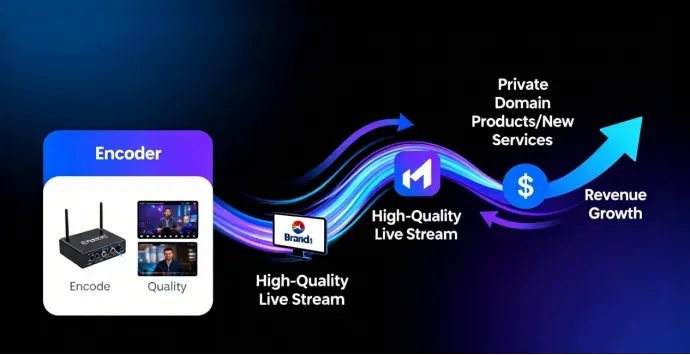
Encoders do more than enable live streaming—they enhance your brand and profits.
Offer Premium Live-Streaming Packages
Encoders allow wedding companies to offer premium live-streaming packages, such as:
- Multi-camera cinematic broadcasts
- 4K live streams
- Private password-protected viewing pages
- Real-time guest interaction features
These advanced options can significantly elevate the perceived value of your services and help differentiate your brand from lower-end competitors.
Expand Market Reach
By providing reliable live-streaming services, wedding companies can attract couples who have family members living overseas or unable to attend in person. This opens the door to a broader market and makes your service uniquely appealing for:
- Multicultural families
- International clients
- Long-distance families
Strengthen Brand Credibility
High-quality and stable live streams directly contribute to stronger brand credibility. When remote guests experience a smooth and beautifully produced broadcast, they are more likely to:
- Share positive feedback on social media
- Recommend your services
This results in organic word-of-mouth marketing, strengthening your brand’s reputation.
Add Upsell Opportunities
Encoders create room for numerous upsell opportunities. Wedding companies can offer add-ons such as:
- Instant highlight clips
- Recorded speeches
- Behind-the-scenes live views
- Drone live-streaming packages
These extra services not only increase revenue but also enrich the storytelling aspect of the wedding.
Boost Operational Efficiency
Professional encoders streamline production workflows, making live streaming more efficient and reducing the need for additional labor. With features like:
- Simplified setup
- Automated streaming
- Reliable performance
Wedding teams can focus more on creative output rather than troubleshooting technical issues.
Create New Business Models
Encoders enable wedding companies to collaborate with photographers, churches, hotels, and event organizers to provide fully integrated live-streaming solutions. These partnerships can:
- Create new business models
- Establish long-term revenue streams
This positions your company as a comprehensive, tech-forward wedding media provider.
8. Conclusion
Wedding live streaming has become an increasingly important service in the modern wedding industry. As couples prioritize inclusiveness, digital memory, and global accessibility, wedding companies must deliver stable, beautiful, and professional live broadcasts.
Encoders sit at the core of this workflow. They transform raw camera signals into reliable streams